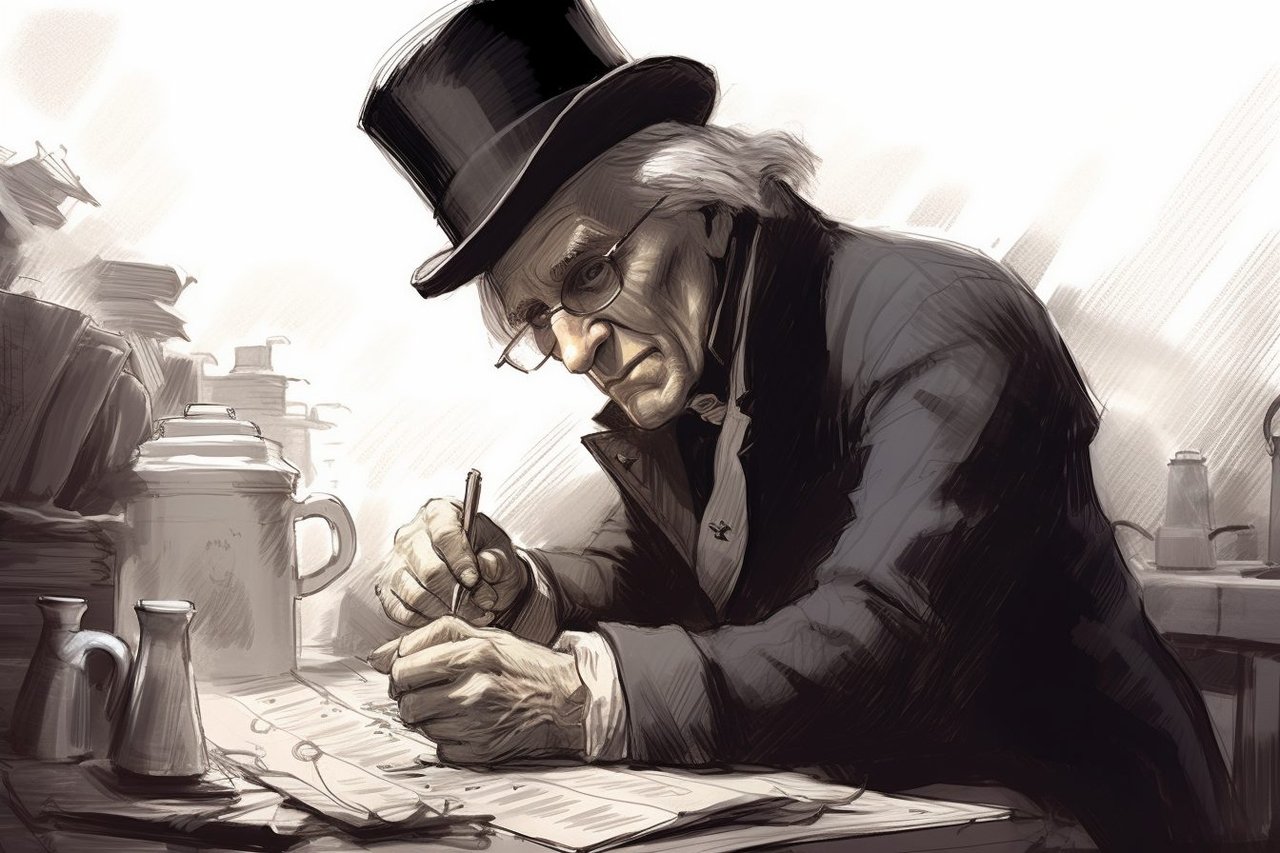
Most people grow up believing Ebenezer Scrooge was a monster.
Cold. Greedy. Penny-pinching.
But the older you get—and the more bills you pay—you start to question whether Scrooge was actually the villain, or if Charles Dickens just needed somebody to blame for the money problems he grew up with and never truly escaped.
Let me tell you a different version of the story. A real one. The one nobody tells because it breaks the myth.
The World Before Mortgages
We forget this now, but in Victorian London—180 years ago—there was no such thing as a mortgage broker, no 30-year fixed rate, no friendly neighborhood credit union. There was no “Building & Loan” like in It’s a Wonderful Life.
If you wanted to buy a home, open a business, expand your shop, or make payroll during a bad season, you had two options:
- Your own savings
- A private moneylender
That’s it.
So who filled that gap?
People like Ebenezer Scrooge.
And let’s get something straight: he used his own money. His own risk. His own capital.
If he lent you £50 and you didn’t pay him back, he absorbed the loss—not a government bailout, not a taxpayer fund, not a depositor pool. He took the hit.
It wasn’t pretty. It wasn’t warm. It wasn’t designed to make you feel good.
But without men like Scrooge, Victorian London’s economy doesn’t function.
Shops don’t open. Ships don’t sail. Warehouses don’t operate. Families don’t buy anything that requires more than a few coins.
Scrooge wasn’t blocking society.
He was funding it.
The Bailey Building & Loan Was Just Scrooge With Softer Lighting
People worship George Bailey like he’s a saint, but let’s be honest here:
- The Building & Loan lent money at interest.
- They used depositor funds to do it.
- If borrowers defaulted, the whole thing collapsed.
- They collected debts or they went out of business.
That’s the same core model as Scrooge—just mutualized and marketed as wholesome.
In fact, it’s riskier from a capital standpoint:
- Scrooge risked his money.
- The Building & Loan risked everyone else’s.
If the town hit hard times, everyone who trusted George Bailey would feel the pain—not just George.
The only reason the Building & Loan looks heroic is because Frank Capra told the story from the borrower’s point of view. Dickens told it from the child of a debtor. Change the narrator, change the morality.
But the economics?
Identical.
The Dickens Family’s Real Ghost of Christmas Past
Let’s talk about Charles Dickens for a second, because this is where the whole myth gets twisted.
Dickens wasn’t poor as an adult. Not even close.
When he wrote A Christmas Carol, he was making the equivalent of about $300,000 a year, and his publishers were threatening to drop his income. He had five kids, a wife, a lifestyle he couldn’t maintain, and extended family he kept bailing out.
He was stressed, panicked, walking London at night trying to figure out how to fix his finances.
So he did what every writer with a deadline and money trouble does: he wrote a book fast. Six weeks. A sprint. He needed the income.
But why did Scrooge become the villain?
Because Dickens’s father had gone to debtors’ prison—twice.
Not because of a moneylender.
Not because of an Ebenezer Scrooge.
His father owed £40 to a baker. Forty pounds.
He didn’t pay his tradesmen.
He lived beyond his means.
He gambled on the idea that “something will turn up,” which was basically his motto.
So imagine being Charles Dickens, age twelve, ripped out of school, forced into a factory to help pay off your father’s everyday bills—not investment loans, not business expansion, not a mortgage, just unpaid household expenses.
You grow up traumatized by your father’s irresponsibility, but you can’t make your father the villain in a Christmas book. You can’t blame the man who raised you.
So you blame the man he would’ve owed money to.
You create a Scrooge.
You invent the debt collector as the monster because the debtor was someone you loved.
That’s how stories become myths.
The Real Deal About Scrooge
Let’s look at this clearly, without the emotional filter:
- Scrooge didn’t take handouts.
- Scrooge didn’t burden society.
- Scrooge didn’t go to prison for debt because he didn’t spend money he didn’t have.
- Scrooge didn’t have five kids he couldn’t afford.
- Scrooge didn’t live beyond his means.
- Scrooge used his own capital to lend money in a society with no other lending mechanism.
- Scrooge kept businesses alive, kept homes from being lost, and kept cash moving in a world without banks for ordinary people.
His flaw? He wasn’t warm. He wasn’t charitable. He wasn’t interested in emotional life.
But guess what?
People who survive by being financially disciplined often aren’t.
Why We Still Villainize Scrooge Today
Because nothing has changed.
Look at New York City today.
Landlords—just like Scrooge—put up their own money, their own credit, their own equity. They buy buildings, fix them, maintain them, pay taxes on them, deal with insurance that goes up every year, comply with regulations that multiply like weeds, and house millions of people.
And somehow, they are the villains.
Just like Scrooge was.
But without landlords?
There is no housing.
Without private capital?
There is no inventory.
Without people willing to leverage their own money?
There are no homes for families.
There are no rentals.
There is no city.
We tell tenants they’re the powerless ones and in some ways they are but let’s be clear: without property owners taking financial risks, tenants don’t even have doors to walk through.
Scrooge represents every owner who keeps the city running but is painted like the enemy because he’s the one who said “no” instead of “yes” when someone couldn’t pay.
But saying “no” is what keeps the entire system afloat.
A society where nobody pays their bills collapses, fast.
Dickens blamed the lender because he couldn’t blame his father.
Modern politics does the same thing for the same reason:
It’s easier to blame the person who collected the debt than the person who didn’t pay it.
The Honest Truth
When you strip away the fiction, the sentimentality, the politics, and the emotional window dressing, you’re left with something simple:
Scrooge wasn’t evil. Scrooge was essential.
In a world with no mortgages, no banks for the working class, no credit lines, no home equity loans, no government guarantees he was the only thing standing between the economy and collapse.
That doesn’t mean he was warm.
It doesn’t mean he was generous.
It doesn’t mean he was enjoyable company.
It just means he was necessary.
And maybe the real lesson isn’t that Scrooge should’ve given more away.
Maybe it’s that Dickens should’ve given more credit to the people who kept Victorian London functioning while others couldn’t or wouldn’t pay their bills.
People like Scrooge built the system.
Dickens’s father broke it.
Dickens himself lived in fear of becoming his father again.
And that’s the real ghost haunting A Christmas Carol.