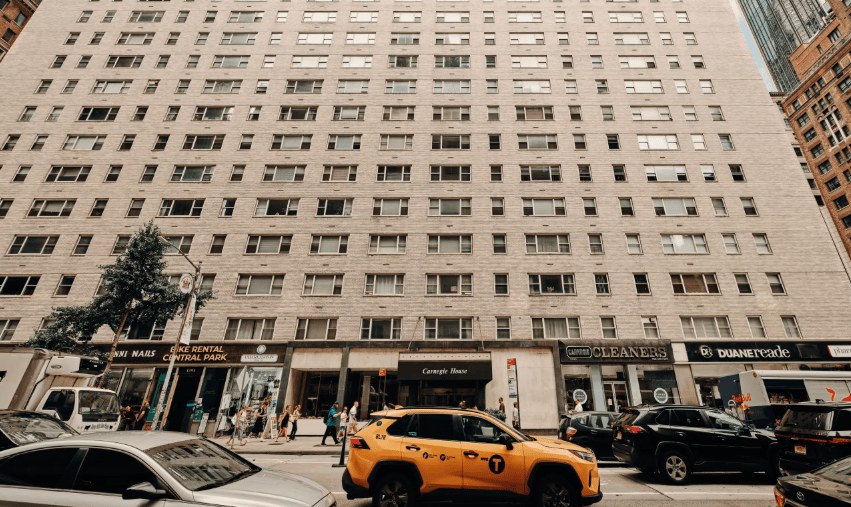
A New York County Supreme Court decision this week sent a jolt through Carnegie House at 100 West 57th Street, authorizing a ground rent reset that amounts to a roughly 450 percent increase. For a building long viewed as one of the last “affordable” footholds on Billionaires’ Row, the ruling is more than a headline. It is a real-time case study in how ground leases can turn a seemingly inexpensive co-op purchase into an unpredictable, and potentially unfinanceable, long-term obligation.
Richard Hirsch, the co-op’s board president, called the decision a devastating blow and warned that many of the building’s approximately 300 shareholders may no longer be able to afford to stay. The board has indicated it plans to appeal.
What makes Carnegie House different: You own the apartment, not the land
Carnegie House is a classic example of a New York structure many buyers misunderstand until it is too late: a long-term ground lease. Shareholders own their co-op shares and the right to occupy their apartments, but the land under the building is owned by a separate entity. The co-op pays “ground rent” to that landowner under a lease that often includes scheduled “reset” provisions.
Ground leases were widely used in the 1950s as a way to lower purchase prices and expand homeownership for middle-class New Yorkers. In a normal market environment, the tradeoff can be manageable. In a market where land values have surged, especially on West 57th Street, the reset becomes a pressure point that can overwhelm the building’s economics.
Why the rent reset is so punishing on Billionaires’ Row
Over the past decade, West 57th Street has experienced an intense wave of ultra-luxury development. That has not just changed the skyline. It has materially increased the underlying land value and, by extension, the leverage that landowners have when ground lease resets arrive.
In Carnegie House’s case, the land is owned by an LLC tied to real estate investors Rubin Schron and David Werner, which acquired the land beneath the building in 2014 for $261 million. The owners have argued that a meaningful portion of the building is held as investment property rather than primary residences, and they have expressed willingness to discuss rental assistance for permanent residents who can demonstrate need.
The ground lease reset had been anticipated for years and was slated for 2025, but anticipation is not the same as certainty. When the numbers became real, the risk profile changed overnight.
The hidden cascade: financing stops, values collapse, owners get trapped
This is where ground lease risk becomes truly dangerous, even for sophisticated buyers.
First, lenders react. As uncertainty rises around future monthly costs, banks often step back from issuing mortgages in the building. That immediately shrinks the buyer pool.
Then pricing breaks. Carnegie House illustrates the pattern. Units are reportedly listed well below typical neighborhood pricing, with examples cited around $100,000 for a studio and roughly $214,000 for a one-bedroom. In other words, the market is attempting to price in a liability that is hard to quantify and impossible to control.
Finally, monthly costs can spike. Hirsch has said his family’s monthly carrying costs could move from roughly $5,000 to about $13,000. Another resident, Lou Grumet, said his monthly cost could rise from around $3,700 to about $9,000. Even if you can afford it, that kind of increase forces lifestyle decisions, refinancing decisions, and in some cases, a forced sale into a thin market.
The nightmare scenario most buyers never consider
If a co-op cannot meet its ground lease obligations and defaults, the consequences can be existential. One risk raised in coverage of Carnegie House is that losing the ground lease could cause the property to revert to a different status, potentially converting apartments into rent-stabilized rentals and effectively wiping out shareholder equity.
The truly brutal detail is that shareholders can still remain responsible for their individual mortgages even if the value of their ownership interest collapses. This is the scenario that turns “cheap on paper” into “expensive for a decade.”
This is the warning buyers need to hear
Carnegie House is not just a building specific story. It is a warning label for any buyer looking at a co-op with a ground lease, especially when the price looks “too good.”
In New York, the right move is not simply to find the cheapest apartment with the lowest entry price. The right move is to understand what you are buying, how the building is structured, and what your downside looks like if the lease economics shift.
Due diligence checklist: What an experienced team should verify before you buy
If you are considering a ground lease co-op, you and your advisor team should be able to answer, in writing, at least these questions:
-
When is the next ground lease reset date, and what formula governs it?
-
What is the current ground rent, and what are realistic ranges after reset?
-
Does the building have reserves, and what is its contingency plan for a large increase?
-
Are lenders currently financing purchases in the building? If yes, which banks and on what terms?
-
What do recent board minutes say about ground lease litigation, negotiations, or forecasts?
-
How are current owners actually coping: assessments, maintenance increases, delinquencies?
-
What is the exit strategy if values drop further and financing tightens?
Bottom line
Carnegie House at 100 West 57th Street is a live example of how a ground lease can transform a co-op from “affordable” into financially volatile, especially in neighborhoods where land values have surged.
If you want, I can rewrite this again in your “broker voice” for a blog post you publish under your name, with a sharper warning to buyers and a clear call to action (including the exact questions you want prospective buyers to ask before they write an offer).