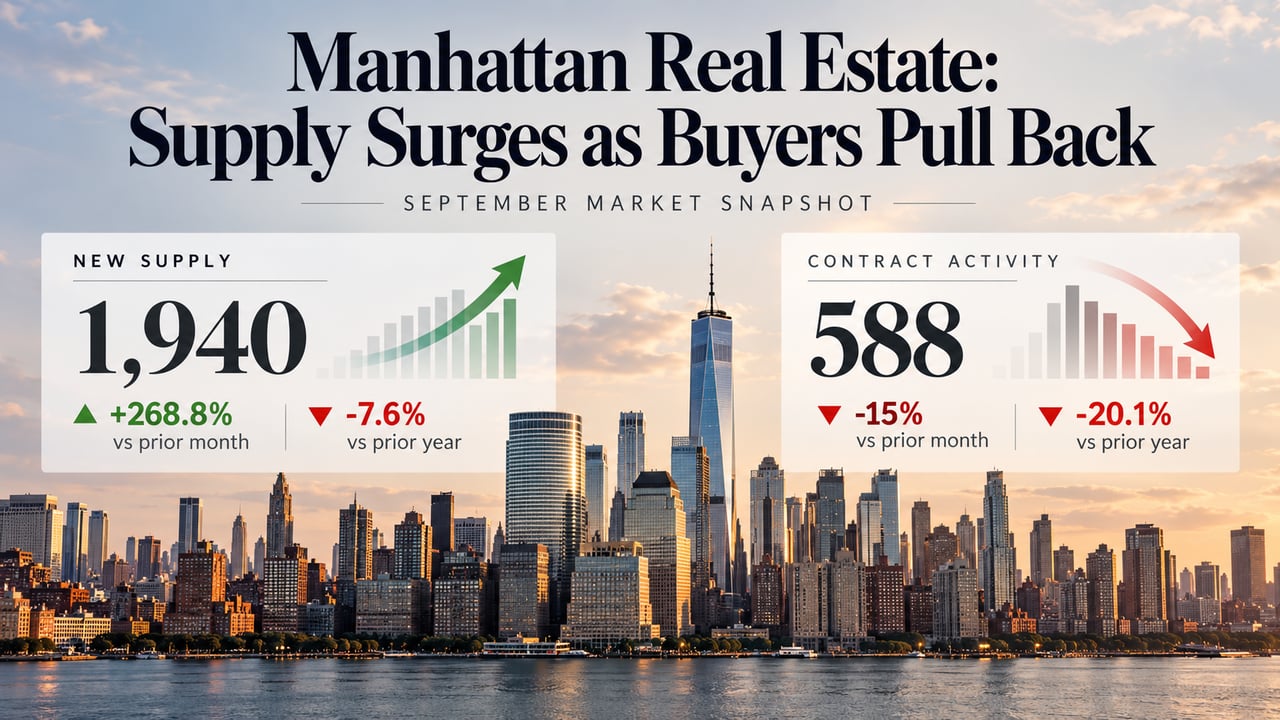
Fewer sales. Fewer listings. Faster deals. And some buyers are still bidding over asking.
I have been selling Manhattan real estate for more than 25 years, and I can tell you that this is one of the strangest markets I have worked through.
Everybody wants a simple answer. Is it a buyer's market or a seller's market? Are prices rising or falling? Should you sell now or wait until next year?
The problem is that there isn't one answer. Two owners in the same building can be dealing with completely different markets.
The numbers don't add up. Or do they?
In October, Manhattan recorded 960 signed condo and co-op contracts, down 14% from the year before, according to Corcoran. That sounds like a weak market.
But the number of homes listed for sale also dropped 9% to 6,187, the lowest October inventory in a decade. And the apartments that did find buyers spent an average of just 91 days on the market, 23% less time than a year earlier. The average discount from the last asking price was only 1%.
Think about that. Fewer contracts. Fewer choices. Homes selling faster. Almost no average discount off the last asking price for the properties that found buyers.
Across New York City, StreetEasy also reported that 21% of homes sold in October closed above their most recent asking price. That's a citywide figure, but it tells you something about how competitive the right property can still be.
We don't have one market. We have several.
A well-priced, renovated apartment with a practical layout can attract immediate attention. Another apartment down the hall, with a dated kitchen, a questionable layout or high monthly carrying costs, can sit for months.
Buyers are cautious, but they are not blind. They are willing to pay for a property that makes sense. What they are no longer willing to do is take on someone else's renovation, an unrealistic asking price and a pile of uncertainty without being compensated for it.
Too many sellers look at the highest sale in their building and decide that is what their apartment is worth. That isn't how this market works. Condition, layout, floor, light, monthly costs and the competition that is actually available today matter more than the headline average.
The luxury market is telling a different story.
According to a November Brown Harris Stevens market analysis, October contracts at $4 million and above were roughly 47% higher than the long-term October average. The broader market has slowed, but serious money is still being put to work at the top end.
Luxury buyers are often less dependent on a conventional mortgage. They may be able to pay cash, borrow against investments or simply wait until they find exactly what they want. That gives them options many other buyers don't have.
Meanwhile, buyers who need financing are dealing with higher borrowing costs and more limited choices. That is why the same market can feel strong to one seller and terrible to another.
What would I do if I owned a Manhattan apartment right now?
First, I would stop paying so much attention to broad market headlines.
If you're thinking about selling, the question isn't whether Manhattan prices are up or down. The question is how many buyers exist for your particular apartment, what else those buyers can purchase and what you need to do to make your property the obvious choice.
If you're buying, I wouldn't assume a slower market means everything is negotiable. There are real opportunities, especially with properties that need work or have been sitting. But the best apartments can still move quickly. Know the numbers and be ready to act when something is actually priced right.
My outlook for early 2027
I expect the first quarter of 2027 to offer more opportunities than the headlines suggest. Wall Street bonus season generally brings buyers back into Manhattan, and if inventory remains limited, well-positioned listings should benefit. But mortgage rates, new supply and the economy can change that picture quickly.
I am not predicting that every apartment will rise in value. I am predicting that the gap between correctly priced homes and everything else will remain significant.
After 25 years and more than 2,500 sales, this is what I know: Manhattan real estate doesn't reward wishful thinking. It rewards owners and buyers who understand the competition in front of them.
The market only makes no sense if you assume every apartment is playing by the same rules.