Manhattan’s Fall Market Just Sent a Warning
Nearly 2,000 apartments came to market in September. Only 588 found contracts. That gap may tell us more about where New York real estate is heading than any headline about prices.
For most of the summer, Manhattan real estate had a convenient explanation for almost everything that was wrong with it.
It was summer.
Buyers were away. Sellers were waiting. Inventory was thin. Families were traveling. Brokers were telling clients to hold off until after Labor Day, when New York traditionally wakes back up and the fall market begins.
Then September arrived.
The sellers showed up.
The buyers did not.
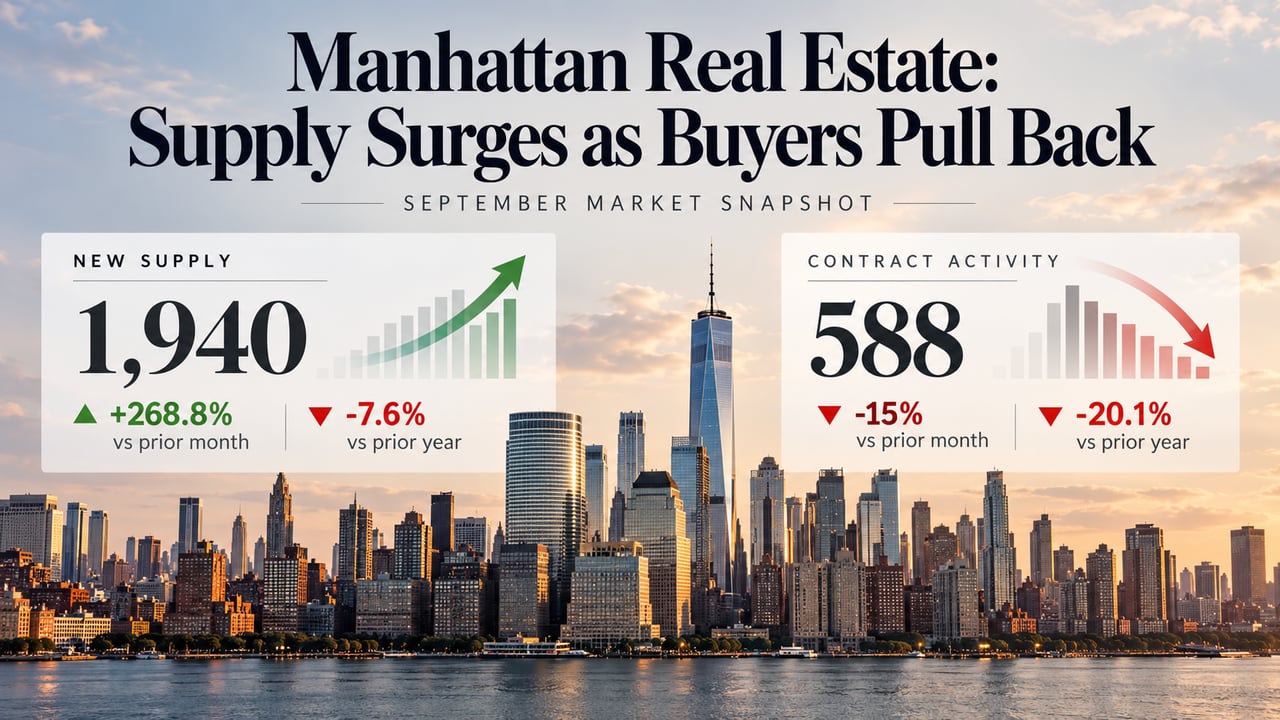
According to UrbanDigs data, 1,940 new Manhattan listings came to market in September, an extraordinary 268.8 percent increase from August. But the number was still 7.6 percent below September of last year.
On the other side of the equation, only 588 contracts were signed.
That was 15 percent fewer than August and 20.1 percent fewer than a year ago. (Howard Hanna NYC)
Those two numbers, 1,940 and 588, may be the most important numbers in the Manhattan residential market right now.
Because this is no longer simply a story about low inventory.
It is becoming a story about hesitation.
And New York has suddenly given buyers quite a few things to hesitate about.
The apartments came back. The demand did not.
September is supposed to create a surge of inventory. That part happened exactly as expected.
Active Manhattan inventory jumped to approximately 5,986 listings, up 33 percent in a single month. Yet inventory remained roughly 11 percent lower than a year earlier, which is an important distinction. Manhattan does not suddenly have too many apartments.
What it has is too many apartments relative to the number of people currently willing to make a decision. (Howard Hanna NYC)
That is an entirely different problem.
The market can absorb a lot of inventory when buyers are confident. It struggles when buyers believe waiting might improve their position.
And there are now signs that sellers are beginning to understand that.
September produced approximately 1,070 price reductions, more than double the number in August. The median discount between asking price and sale price widened to about 3.8 percent. (Howard Hanna NYC)
None of this means Manhattan real estate is collapsing.
In fact, that is what makes the current market so interesting.
Prices are holding up remarkably well.
The September median sale price was approximately $1.26 million, while median price per square foot was roughly $1,443, up about 8 percent from a year earlier. Pending sales were also still running ahead of last year. (Howard Hanna NYC)
The third-quarter numbers tell the same contradictory story.
Manhattan recorded 3,625 closings in the third quarter, up 9 percent from a year ago and the strongest third quarter since 2022. Dollar volume reached approximately $7.3 billion. The median sale price hit a third-quarter record of $1.25 million.
Sales above $3 million increased 25 percent year over year.
Yet contracts signed during the quarter fell 6 percent. (Inhabit | A Blog from Corcoran)
That matters because closings tell us where the market was.
Contracts tell us where the market is going.
New York now has a confidence problem
Real estate markets rarely turn because everybody wakes up one morning and decides apartments are worth less.
They turn because buyers become uncertain.
And uncertainty causes something incredibly powerful in real estate.
It causes people to wait.
A buyer who believes an apartment is worth $3 million might still pay $3 million.
A buyer who wonders whether it will be worth $2.7 million six months from now often does nothing.
That is the psychology I believe Manhattan is fighting right now.
Mortgage rates are certainly part of it.
The average 30-year fixed mortgage reached 7.28 percent on October 1, up from 7.03 percent only one week earlier and 6.34 percent a year ago, according to Freddie Mac. (Freddie Mac)
For Manhattan, where cash buyers make up a significant portion of the market, mortgage rates do not tell the whole story. But money has a price even when you are paying cash.
A buyer deciding whether to put $3 million into an apartment is comparing that investment against every other place that $3 million can go.
At 7 percent mortgage rates and elevated bond yields, the opportunity cost of owning real estate becomes very different.
But interest rates are only one part of what has changed.
The other is City Hall.
Mamdani may be changing the calculation
Mayor Zohran Mamdani did not create today's interest rates. He did not create Manhattan's affordability crisis. He did not create the decades-long shortage of housing production that helped make New York one of the most expensive cities in the world.
But his administration is increasingly becoming part of the calculation buyers make when deciding whether to put capital into New York City residential real estate.
The most obvious example is the city's new non-primary residence surcharge, better known as the pied-à-terre tax.
For the 2026-27 and 2027-28 tax years, the surcharge potentially applies to qualifying non-primary residences, including one- to three-family properties valued by the Department of Finance above $5 million and condominium or cooperative units meeting the applicable DOF valuation threshold.
Depending upon the property and valuation category, the surcharge can become substantial. (New York City Government)
The Mamdani administration describes the policy very differently from much of the real estate industry.
Its argument is straightforward: somebody wealthy enough to maintain a multimillion-dollar second home in New York can afford to contribute more toward the city that makes that property valuable in the first place. The administration has projected roughly $500 million in annual revenue from the program. (New York City Government)
That argument will resonate with plenty of New Yorkers.
But real estate markets do not vote.
Capital does.
And capital is remarkably unemotional.
A person considering a $10 million apartment in Manhattan is not required to buy one.
Miami exists.
Palm Beach exists.
Connecticut exists.
Texas exists.
London exists.
For decades, part of New York's extraordinary strength has been that wealthy people from around the country and around the world wanted to own a piece of it even when they did not technically need to.
That discretionary buyer is enormously important to the luxury market.
If New York makes owning that apartment progressively more expensive, more complicated or politically uncertain, some percentage of those buyers will simply decide not to purchase.
The critical question is not whether every wealthy buyer leaves.
They won't.
The question is what happens if 10 percent of the marginal buyers hesitate.
In a market already producing 1,940 new listings against just 588 monthly contracts, that matters.
A lot.
The tax may matter less than the message
The pied-à-terre surcharge is already facing substantial legal challenges.
A New York judge recently ordered the city to redo parts of the implementation process after finding problems with the rollout. The Mamdani administration appealed, and the litigation continues. The decision did not simply erase the underlying tax, but it added another layer of uncertainty around its administration. (Reuters)
That legal battle might ultimately become as important psychologically as it is financially.
Markets hate uncertainty more than they hate bad news.
Give an investor a $100,000 bill and he can calculate it.
Tell him the bill could be $50,000, $100,000 or $200,000 depending upon legislation, litigation, valuation methodology and what the government does next, and he may postpone the purchase entirely.
That is the danger.
Not necessarily a mass exodus.
A pause.
And 588 contracts in a city carrying nearly 6,000 active Manhattan listings demonstrates what a pause can look like.
But there is another side to this story
It would be intellectually dishonest to blame September's slowdown entirely on Mamdani.
The data does not support that conclusion.
Mortgage rates surged. September had an unusually late Labor Day. Buyers need time to see new inventory, negotiate deals, hire attorneys and sign contracts. A listing can appear online in five minutes. A signed contract often takes several weeks.
Some of September's 1,940 new listings may therefore become October's contracts.
There is also genuine underlying strength in the market.
Third-quarter closings were the strongest in four years. Properties that sold went into contract faster than they did a year ago. Prices remain firm. High-end sales have actually outperformed much of the lower market. And Manhattan's overall inventory remains historically constrained. (Inhabit | A Blog from Corcoran)
That is not the profile of a market in crisis.
It is the profile of a market approaching an inflection point.
And October may tell us which direction it takes.
This is where sellers need to pay attention
For sellers, the mistake right now is looking at a neighbor's closing from six months ago and assuming that is today's market.
It isn't.
A closed sale is historical information.
Your competition is the apartment that went on StreetEasy this morning.
There are now nearly 2,000 fresh September listings competing for buyers' attention. Buyers have more choices. They know contracts are down. They know price reductions are increasing. They know sellers who launched in September have a relatively short window before Thanksgiving and the year-end slowdown.
That changes negotiating leverage.
A seller who prices correctly can still do exceptionally well.
A seller who begins 10 percent too high and plans to "test the market" may discover that the market is testing them instead.
And buyers should not confuse leverage with collapse
Buyers have more negotiating power today than they had several months ago.
That does not mean Manhattan apartments are suddenly cheap.
The best apartments remain scarce.
Great buildings, great layouts, outdoor space, protected views and truly exceptional properties still attract buyers. Manhattan's structural shortage of quality housing has not disappeared because September contracts were weak.
But there is a meaningful difference between today's market and the frenzy buyers experienced during stronger cycles.
They can negotiate.
They can walk away.
They can compare.
And increasingly, sellers know it.
The next number matters more than the last one
I have worked through enough New York real estate cycles to know that one month never tells the whole story.
But sometimes one month tells you where to look.
September gave us 1,940 new listings and 588 contracts.
That is more than three new listings entering the market for every contract signed during the month.
I don't think that statistic should be dismissed as seasonal noise.
Nor do I think it means Manhattan real estate is about to fall apart.
I think it is something much more interesting.
It is a warning.
New York still has enormous demand. It remains one of the world's great stores of residential real estate wealth. Prices remain remarkably resilient. Inventory remains constrained by historical standards.
But for the first time in a while, sellers are arriving faster than buyers.
At the same moment, mortgage rates have crossed back above 7 percent and New York's political leadership is experimenting with policies that directly change the economics of owning expensive residential property.
Any one of those things would be manageable.
Together, they create uncertainty.
And uncertainty is the one thing that can turn a strong real estate market into a slow one without prices initially moving very much at all.
That is why I would not spend the next month obsessing over Manhattan's median sale price.
Watch contracts.
If October's contract activity catches up with September's surge in inventory, this will have been exactly what many brokers hope it was: a delayed beginning to the fall market.
But if October and November arrive and buyers still refuse to absorb the inventory, sellers will eventually have only one mechanism left to create demand.
Price.
And that is when the story gets considerably more interesting.