Nothing happening in real estate right now is really new. In fact, in some ways we are going back to the industry I entered in the 1990s.
Back then, real estate agents controlled the information. Buyers couldn't simply go online and see virtually every property available. Sellers couldn't put a home on one platform and have it distributed everywhere. If you wanted access, you needed an agent.
And believe me, that was great for real estate agents.
But it didn't necessarily make us better advisors. It made us gatekeepers.
Over the last 25 years, technology slowly changed that. Listings became easier to find. Sales data became easier to analyze. Buyers could educate themselves before ever calling us. Sellers could see what their competition looked like. And agents had to evolve from being the people who possessed the information into people who could actually interpret it, negotiate around it and advise clients what to do with it.
I think that made our industry better.
Barbara Corcoran was an early leader in bringing information to the public. The Corcoran Report, launched in 1981, was one of the first serious attempts to give consumers actual market data, and Corcoran was also an early NYC brokerage to embrace the internet.
Now the pendulum appears to be swinging back.
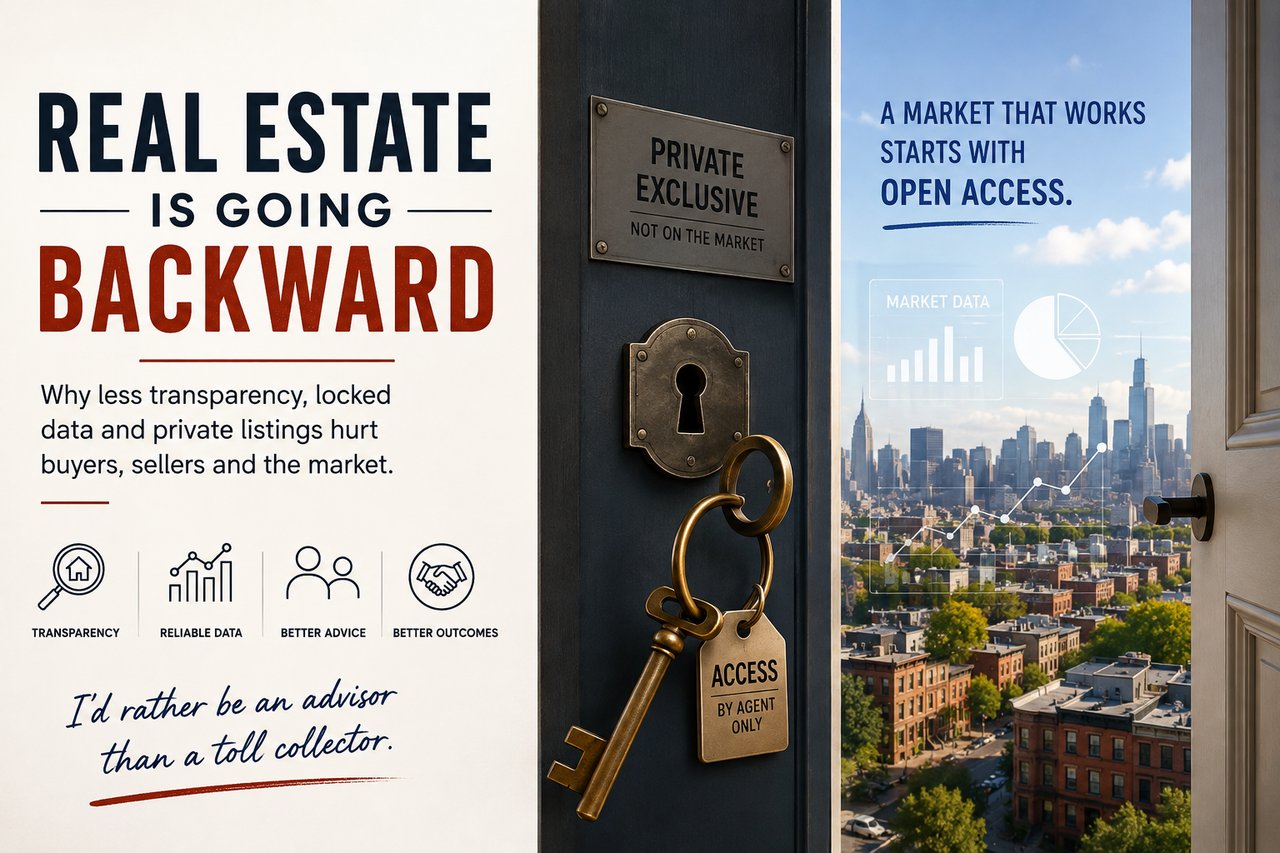
Compass has aggressively promoted its three-phase marketing strategy, where properties can begin as Private Exclusives before eventually reaching the broader public marketplace. Compass argues this gives sellers control, protects price history and allows agents to test the market before a full launch. Compass has even produced data saying properties using its phased strategy achieve better outcomes. Critics argue that withholding inventory, even temporarily, reduces transparency and fragments the marketplace.
I understand why a real estate company wants this.
Information is power.
The less information the public has, the more valuable access becomes. Buyers need agents to discover inventory. Sellers need large brokerage networks to reach buyers. Large firms control more of the transaction instead of competing with Zillow, StreetEasy and other technology platforms for the consumer.
The problem is what happens to the data.
If an apartment takes five months to sell in an open market, that tells us something. We can use that information to advise the next seller about pricing, presentation and demand.
But what if that property spent months being shown privately before appearing publicly? Was it really on the market for 30 days or 150 days? Was the original asking price really $3 million, or was it privately tested at $3.5 million first?
Suddenly, one of the most valuable things our industry has spent decades creating, reliable market data, becomes less reliable.
Investors, appraisers, sellers and buyers are making decisions from an incomplete picture. And that concerns me far more than whether Zillow or Compass wins the corporate battle.
We are seeing something similar in rentals. The intention behind changing New York City's broker-fee rules was to help renters. Yet the rental market has become extraordinarily difficult, inventory remains tight and rents continue reaching records. StreetEasy's own analysis found the FARE Act was associated with higher asking rents on broker-represented apartments, although the much larger problem remains New York's severe housing shortage.
Ironically, making the market more complicated can make agents more necessary, not less. That may be good for my business. I'm just not convinced it's good for my clients. I don't want somebody hiring me because I have the key to a locked door. I'd rather have them hire me because the door is wide open, they can see everything themselves, and they still believe my experience, judgment and advice will help them make a better decision.
I would much rather be an advisor than a toll collector.